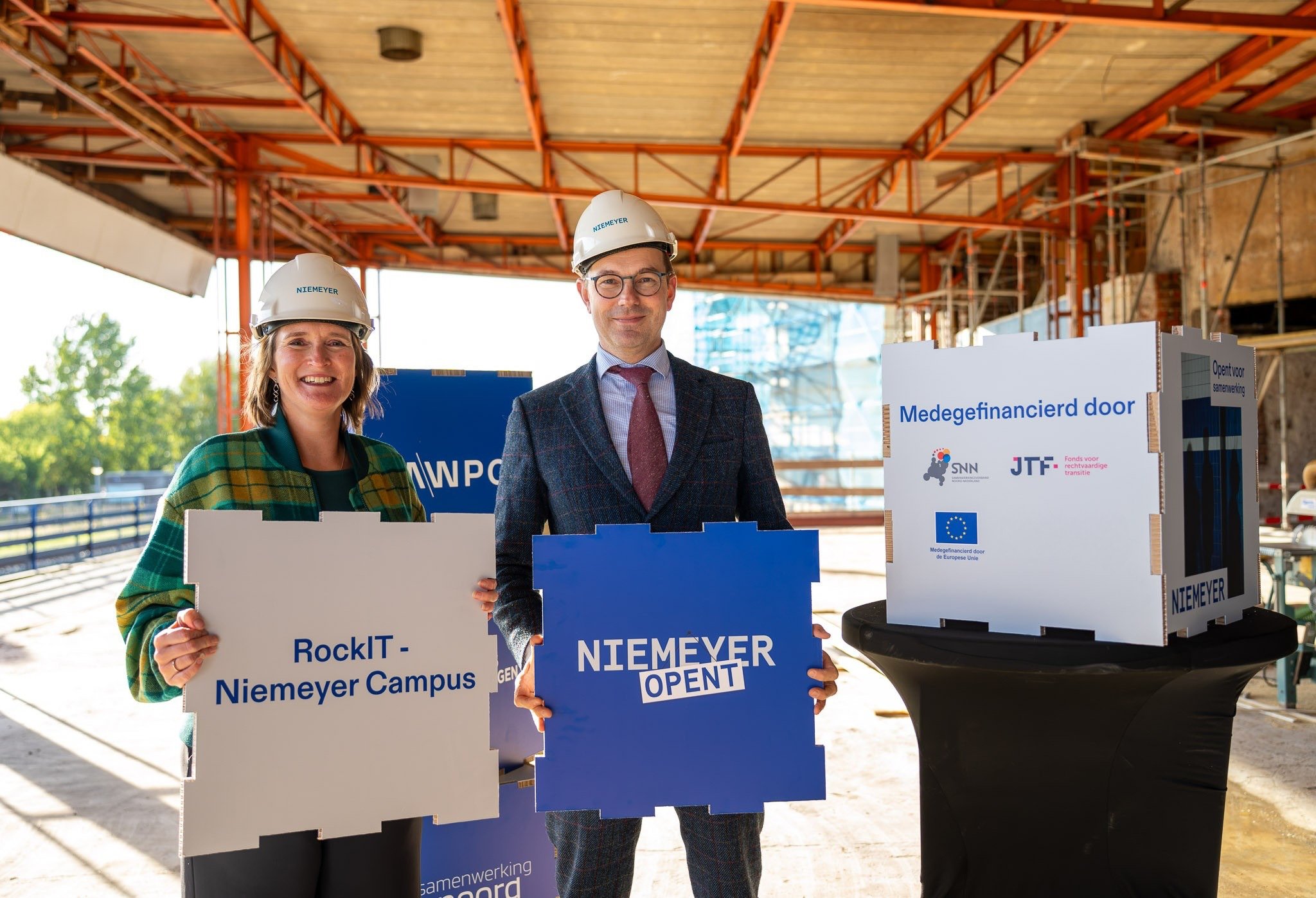
On Monday, construction began on Niemeyer’s Shared Facilities at the former Niemeyer tobacco factory on Paterswoldseweg: approximately 6,500 square meters of shared facilities for startups, innovation teams, and knowledge institutions. The facilities consist of shared learning, work, and meeting spaces, labs, and event space. Provincial Executive Member Erik Jan Bennema (Province of Groningen) and City Councilmember Carine Bloemhoff (City of Groningen) jointly unveiled a symbolic funding block at the construction site. The construction is made possible in part by RockIT, a program worth approximately €22 million that accelerates the digital transition of the Northern Netherlands. Nearly €10 million of that amount comes from the European Just Transition Fund for the Groningen-Emmen region.
The Shared Facilities will be the beating heart of collaboration on the Niemeyer campus. This is where companies, students, and researchers come together every day: in an inspiring environment where students and professionals continue to develop their skills, and in labs where companies and research institutions work together on digital challenges. Completion is scheduled for fall 2027.
Niemeyer’s iconic factory produced tobacco products on Paterswoldseweg from 1904 to 2023. This 40,000-square-meter industrial heritage site is now being transformed into an open urban space for digital innovators, founders, knowledge institutions, and above all, the people of Groningen, with digital transformation as the overarching theme. The shared facilities (6,500 m²) are operated by Niemeyer Services B.V., a partnership between real estate developer MWPO and Campus Groningen.
Koen Atema, Project Manager for the Niemeyer Campus Development: “Today marks the beginning of the development of the place that will soon be at the heart of the Niemeyer project. We’re developing a shared space where talent, entrepreneurs, and researchers can come together around the same table. Soon, this will be a place where small teams with big ambitions can thrive. Here, a network is taking shape that learns and innovates together.”
RockIT is a key building block for the ambitions at the Niemeyer site. Partly thanks to this program, a campus facility is being created that focuses on digital development. The digital business community, in collaboration with all regional educational institutions (from vocational to university level), is developing modular continuing education and retraining programs for workers in the digital sector. By April 2029, more than 1,000 participants are expected to take part in these programs through twelve learning communities, twelve training courses, and three traineeships. The lead partner of RockIT is Niemeyer Services; the other partners in the consortium are Samenwerking Noord (the association of more than 120 companies and organizations from the northern digital sector) and Niemeyer CV. The grant is provided by the Northern Netherlands Partnership (SNN) through the European Just Transition Fund.
Provincial Executive Member Erik Jan Bennema: “The digital transition is of great importance for the future viability of our regional economy. The substantial contribution from the Just Transition Fund toward the development of the digital campus encourages collaboration between businesses and research institutions in this necessary development.”
Councilwoman Carine Bloemhoff: “With Niemeyer, we’re giving an iconic location in our city a new future. This is where entrepreneurs, educational institutions, and research organizations come together, and where talent is given the space to develop. In this way, we’re offering young people opportunities and strengthening Groningen as a city and region where talent wants to stay and build a future.”
Following the unveiling, project partners and officials discussed the significance of the program. Niemeyer Campus is the place where the northern region’s ambition for digital transformation becomes a reality: a hub where the business community, education, and government jointly invest in digital skills and innovation. As such, the campus also serves as an example of how the European Just Transition Fund is being used to make the regional economy more future-proof.